Education 14/11/2025 Nichita Roilean, Founder 6 min read
3D Printing in Schools: Bring Education to Life
3D printing boosts student interest in STEM subjects by up to 40% and helps students retain up to 70% more information through hands-on physical models.
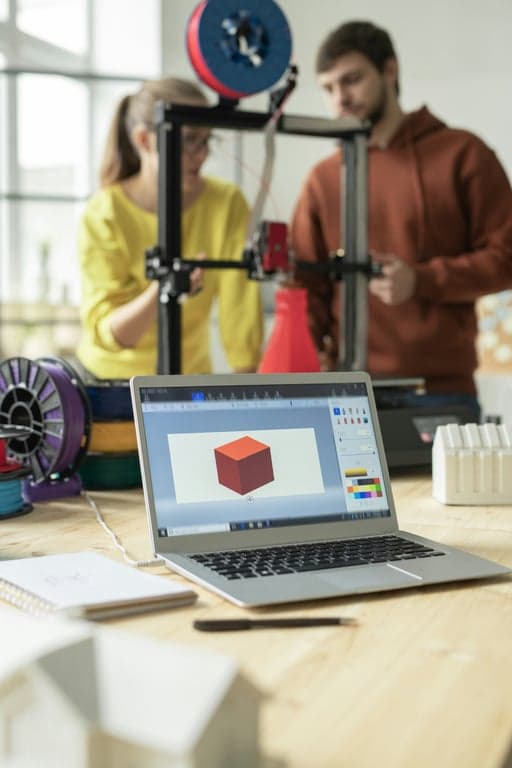
3D printing in schools demonstrably increases student interest in STEM subjects by up to 40%, and students working with physical 3D models retain up to 70% more information than those studying from illustrations alone. Educational aids can be produced on demand from safe PLA or PETG — without the school needing its own printer.
Imagine a biology class where students can touch a real model of the human heart with visible chambers and valves. Or a history class where they hold a replica of an ancient amphora in their hands. 3D printing is bringing a revolution to education – transforming abstract concepts into tangible objects and dull theory into practical experience that truly engages students.
Why 3D Printing Belongs in Schools?
Today's generation of students grows up surrounded by technology and expects interactive and practical forms of learning. Traditional teaching based solely on textbooks and blackboards loses effectiveness. 3D printing offers a natural bridge between the digital and physical worlds and brings a number of specific advantages:
How Does 3D Printing Improve Understanding of Complex Concepts?
Students remember and understand information much better when they can see and touch it from all sides. 3D models allow visualization of what would otherwise remain only a drawing or text in a textbook. A DNA double helix model that you can disassemble teaches far more effectively than any image. Research shows that students working with physical 3D models retain up to 70% more information compared to those studying from illustrations only.
Increased Engagement and Motivation
Working with 3D printing technologies naturally motivates students. Creating one's own design and then printing it is a very satisfying process that encourages creativity and experimentation. Students learn to solve problems, iterate, and improve their designs – key skills for the 21st century.
Practical Preparation for the Future
3D printing is rapidly becoming a standard in many industries – from automotive to medicine to aerospace. It is estimated that by 2030, knowledge of additive manufacturing will be required for more than 20% of technical positions. Students who familiarize themselves with this technology in schools gain a significant advantage for their future education and careers.
Specific Uses of 3D Printing in Individual Subjects
3D printing isn't just about technical subjects – it can enrich virtually every teaching area.
Natural Sciences: Biology, Chemistry, Physics
Biology:
- Models of organs and organ systems (heart, lungs, brain) for anatomy study
- Models of cells with visible organelles (nucleus, mitochondria, chloroplasts)
- Replicas of skeletal systems and individual bones
- DNA models for understanding genetics
- Fossils and evolution – replicas of extinct species
Chemistry:
- 3D models of molecules and chemical structures that can be assembled and disassembled
- Visualization of crystal lattices
- Models of atoms and electron orbitals
Physics:
- Functional models of simple machines (lever, pulley, inclined plane)
- Demonstrations of mechanical principles (gears, transmissions)
- Visualization of waves, optics, and other physical phenomena
Mathematics and Geometry
- 3D models of geometric solids (cone, cylinder, cube, pyramid)
- Fractals and geometric patterns
- Visualization of mathematical functions and graphs
- Aids for students with special needs
History and Geography
History:
- Replicas of historical artifacts and tools
- Models of historical buildings and monuments
- Reconstructions of ancient objects for more tangible learning
Geography:
- Topographic maps with relief
- Models of volcanoes, geological formations
- Globes and maps of continents
Technical Subjects and STEM
- Design and printing of own projects
- Rapid prototyping – students learn to design, test, and refine
- Robotics – printing parts for robotic projects
- Electronics – enclosures and covers for Arduino and other projects
Art and Design
- Creation of statues and sculptures
- Jewelry design
- Architectural models
- Creative projects and artworks
How to Start with 3D Printing in School?
Introducing 3D printing into education doesn't have to be complex or costly. There are several approaches depending on the school's capabilities and needs.
1. In-house Printer vs. External Service
In-house Printer in School:
- Advantages: Fast availability, students see the entire printing process, opportunity to experiment
- Disadvantages: Initial investment (entry-level printers from approx. €300), maintenance requirements, need for staff training
- Suitable for: Schools with a technical focus, secondary schools, and universities
External 3D Printing Service:
- Advantages: No equipment investment, professional print quality, wide range of materials
- Disadvantages: Delivery waiting time, lower flexibility
- Suitable for: Primary schools, schools new to 3D printing, simple projects
2. Ready-made Models vs. Students' Own Designs
To start, you can use databases of free models (Thingiverse, Printables, MyMiniFactory), where you'll find thousands of educational aids ready for printing. This allows for quick integration of 3D printing into teaching without the need to design custom models.
More advanced students can use CAD software (TinkerCAD, Fusion 360 – free for students, Blender) and design their own models. This is ideal for project-based learning and the development of technical skills.
3. Funding and Grants
For schools, there are numerous grants and subsidies aimed at supporting technology in education:
- Jan Amos Comenius Operational Programme
- Templates for Schools
- Local foundations and funds
Practical Project Examples for Various Age Groups
Primary Schools (Grades 1–5)
- Simple geometric shapes and puzzles
- Models of animals and plants
- Personalized keychains and name tags
- Stamps with initials
Middle Schools (Grades 6–9)
- Topographic maps of the local area
- Models of cells and DNA
- Historical artifacts
- Functional mechanisms (gears, pulleys)
High Schools
- Complex projects – product design and prototyping
- Robotic components
- Architectural models
- Scientific aids and laboratory equipment
Safety and Suitable Materials for Schools
When selecting materials for school projects, attention must be paid to safety and harmlessness:
- PLA (Polylactic Acid): Safest choice for schools, non-toxic, odorless, made from renewable resources
- PETG: Safe, more durable than PLA, no toxic fumes
- Avoid: materials producing toxic fumes or requiring high print temperatures
Always ensure adequate ventilation in the room where printing is taking place, and never leave students unsupervised with a running printer.
How 3D Printing Develops Key Competencies
Working with 3D printing isn't just about technology – it develops a wide range of important skills:
- Critical Thinking: Problem analysis and solution design
- Creativity: Designing new and original solutions
- Collaboration: Teamwork on projects
- Digital Literacy: Proficiency in CAD software and technologies
- Perseverance: Learning from mistakes and iterative improvement of designs
- Spatial Imagination: Visualization of 3D objects
Have Custom Educational Aids Made for You
You don't have to invest in your own printer right away. We offer comprehensive 3D printing services for educational aids to schools. We collaborate with teachers to create models precisely according to their needs and curricula – from anatomical models to historical replicas and interactive mathematical aids.
Our models are printed from safe materials (PLA, PETG) and are designed to withstand daily classroom use. Contact us and let's bring education to life in your school together.