Technology 08/10/2025 Nichita Roilean, Founder 6 min read
How 3D Printing Transforms Product Development
3D printing cuts product development cycles by 50–90% and delivers a physical prototype within 24 hours of a digital design — with no expensive molds.
3D printing cuts product development cycles by 50–90% and can deliver a physical prototype within 24 hours of a digital design — without expensive molds, demonstrating shortening product development cycles in practice. ABB Robotics, for example, reduced robotic finger prototyping time from 5 weeks to just 1 hour — the same agility that lets you fix it instead of throwing it away when a part fails.
3D printing has evolved from a niche technology into a strategic tool, enabling companies to dramatically accelerate and streamline the journey from initial idea to final product. In today's competitive environment, speed of innovation is no longer just an advantage, but a necessity for survival. Additive manufacturing offers the key to gaining a decisive competitive edge, reducing costs, and opening doors to design possibilities previously unthinkable.
This article will guide you through the world of rapid prototyping and show how Czech companies can leverage the potential of 3D printing to strengthen their competitiveness.
What is Rapid Prototyping and Why is it Key Today?
Rapid Prototyping is a set of technologies that enable lightning-fast production of physical models directly from digital 3D data (CAD). Unlike traditional methods, such as CNC machining (where material is removed), 3D printing works on an additive principle – building an object layer by layer. This approach eliminates the need for expensive molds and tools, making the production of individual pieces or small series significantly faster and cheaper.
Prototypes serve various purposes:
- Visual models: Materialize the initial idea, verify ergonomics and product appearance.
- Functional prototypes: Simulate mechanical properties and allow real-world load and performance testing.
- Pre-production prototypes: Closely resemble the final product and serve for final validation before mass production begins.
What Are the Main Benefits of 3D Printing for Your Business?
Integrating additive manufacturing into company processes brings significant strategic advantages that go far beyond just model production.
1. Radical Shortening of Development Time (Time-to-Market)
The most significant benefit is the dramatic shortening of development cycles. Prototypes that previously took weeks can be ready in a few hours with an in-house 3D printer. This agile "design-print-test" approach allows for several design iterations in a fraction of the original time. For example, Česká zbrojovka accelerated prototype preparation by up to 50%, while ABB Robotics reduced robotic finger prototyping time from five weeks to one hour.
2. Significant Cost Savings and Fast Return on Investment (ROI)
3D printing eliminates the need for expensive molds for prototypes and minimizes material waste. Traditional injection mold tooling typically costs €2,000–€20,000; 3D printing eliminates this cost entirely in the prototyping phase. Even more importantly, early detection of design flaws prevents costly modifications to final production tools. An investment in a professional 3D printer can therefore pay for itself within a few weeks or months.
3. Unrestrained Design Freedom
Additive manufacturing frees designers from the limits of traditional technologies. It allows for the creation of highly complex geometries, internal lattice structures for part lightweighting, or integrated assemblies that would otherwise be unmanufacturable. This opens the door to generative design, where software itself proposes the most efficient part shape.
4. Risk Minimization and Support for Innovation Culture
The ability to quickly and cheaply test dozens of design variants fundamentally reduces the risk associated with development. Companies can shift from an "all-or-nothing" model to a gradual product evolution. The availability of 3D printing also democratizes innovation and fosters creativity across the entire company.
The 3D Printing Process in a Nutshell: From Model to Prototype
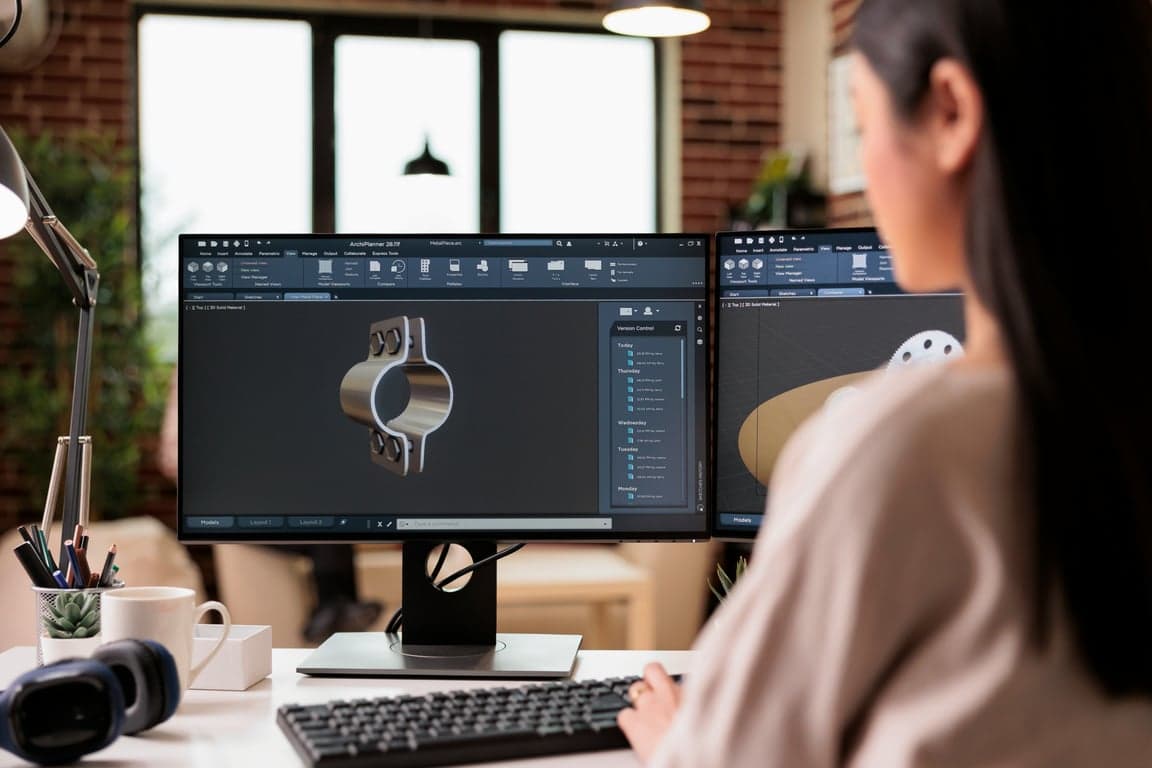
- Digital Design (CAD): Everything starts with creating a 3D model in specialized software (e.g., SolidWorks, Fusion 360). The model is then exported to STL format.
- Preparation for Printing (Slicing): Software called a "slicer" (e.g., PrusaSlicer) converts the 3D model into individual layers and generates instructions for the printer (G-code). Here, key parameters such as layer height, infill density, and necessary support structures are set.
- Printing: Based on the G-code, the printer progressively builds the object layer by layer.
- Post-processing: The raw print almost always requires final adjustments – removing supports, sanding, painting, or polishing to achieve the desired appearance and functionality.
FDM Technology — What Niro3D Offers
Niro3D uses FDM (Fused Deposition Modeling) — the most widespread and affordable 3D printing process, which melts plastic filament layer by layer.
Materials we stock:
- PLA — strong, easy-to-print plastic from renewable sources; ideal for decorative parts, holders, and everyday spare components
- PETG — more resistant to heat, moisture, and mechanical stress; suitable for functional parts indoors and out
- PLA Silk / Galaxy — PLA variants with glossy or shimmering finishes for aesthetic parts
FDM with these materials covers the vast majority of spare parts for home, office, automotive, and small-appliance applications. For specialized industrial cases (metal parts, high-temperature polymers like PEEK, large-batch MJF/SLS production), dedicated services exist — but they are incomparably more expensive and slower to deliver.
Practical Examples: 3D Printing in Czech Industry
Škoda Auto: A Strategic Pillar of Production
The Czech car manufacturer is a prime example of deep 3D printing integration. It operates extensive print farms with dozens of printers, serving not only for prototype production but also for assembly fixtures.
- Crisis management: During a supply chain disruption, production was threatened with shutdown. Teams at Škoda managed to design and print spare parts within hours, preventing delays in the delivery of 13,000 vehicles.
- Metal printing: DED technology is used for quick and inexpensive repairs of damaged foundry molds, which is significantly more economical than producing new molds.
Other industries:
- Healthcare: Olomouc University Hospital uses 3D printed organ models for preparing for complex surgeries, shortening operating room time and increasing procedural safety. In dentistry, 3D printing is standard for producing implants and surgical guides.
- Aerospace industry: 3D printing enables the production of lighter and stronger optimized parts. The Mars rover Perseverance carries eleven key components made by 3D metal printing.
How to Start with 3D Printing in Your Company?
When deciding on implementation, companies face a choice between in-house production and outsourcing.
| Approach | Advantages | Disadvantages |
|---|---|---|
| In-house production | Maximum speed and flexibility, intellectual property protection, lower long-term per-part costs. | Higher initial investment, need for staff training, maintenance costs. |
| Outsourcing | Immediate access to expensive technologies without investment, expert consulting. | Longer delivery times, higher per-part cost, potential security risk. |
For many companies, a hybrid model is ideal: acquiring their own FDM printer for common tasks and utilizing external services for specific projects, such as metal printing.
When choosing a professional printer, reliability, an enclosed and heated print chamber for technical materials, and especially quality technical support and service are key.
The Future is Additive
The line between prototype and final product is blurring. Trends like new composite and sustainable materials, the combination of 3D printing with artificial intelligence for generative design, and the shift to local on-demand manufacturing will further strengthen the role of additive manufacturing. Companies are moving from physical spare parts warehouses to digital warehouses, where they simply print the needed part.
Conclusion: Innovation as the New Standard
Rapid prototyping using 3D printing is no longer a technological curiosity but a fundamental part of modern innovation strategy. The ability to transform an idea into a physical prototype in a matter of hours gives companies unprecedented agility and a competitive advantage. For Czech businesses, the question is not "whether" to adopt this technology, but "when and how," to maintain their position in a global market where speed determines success.