Business 19/06/2026 Nichita Roilean, Founder 7 min read
Need Something Made? Custom Parts Without a Factory
Need one bracket, five fixtures, or a single replacement part? On-demand 3D printing gives B2B teams an instant price and 48-hour delivery — no quotes, no minimums, no factory.
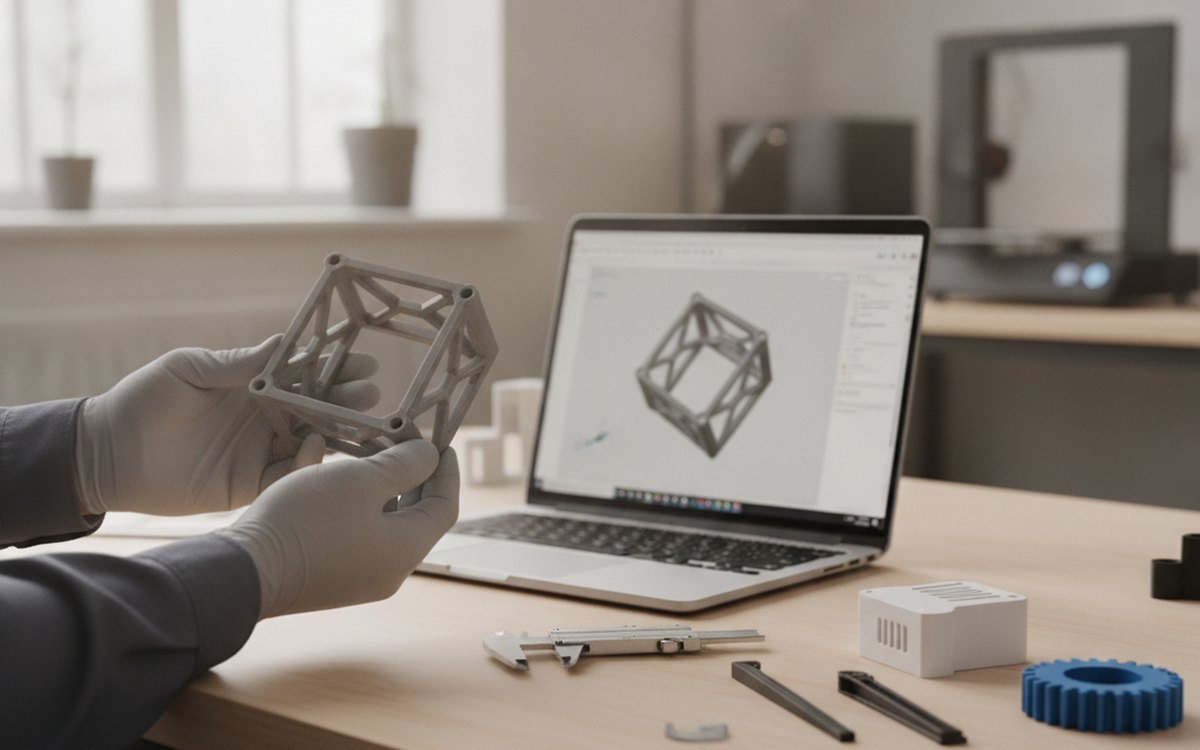
You need a bracket. Or a custom enclosure. Maybe a jig, a fixture, or a replacement part for a machine that hasn't been in production for six years. You know exactly what it needs to do — you might even have the CAD file on your desktop right now. What you don't want is a three-day wait for a quote, a supplier with a 50-unit minimum, or an email thread that goes quiet over the weekend.
That's the situation most mechanical engineers, product managers, and R&D leads at EU SMEs deal with constantly. The part is simple. The need is real. The process to get it made is not.
Here's what actually works in 2026.
The Problem With Traditional Manufacturing for Small Runs
Traditional suppliers are built for volume. Their pricing assumes hundreds of units. Their quoting process assumes you have time to spare.
When you need one prototype, five test fixtures, or a single replacement part, you fall into a gap that rapid prototyping at large suppliers usually doesn't cover. Too small for the factory floor, too technical for a general supplier, too time-pressured for a back-and-forth RFQ process.
The result: engineers spend hours on admin instead of engineering. Projects stall. Deadlines slip because a €12 part took two weeks to source.
What "On Demand" Actually Means for Custom Parts
On-demand manufacturing means you define the part, get a price, and order — with no sales rep in the loop.
For custom parts at prototype or low-volume scale, 3D printing is the most practical on-demand option available in Europe right now. It handles a wide range of geometries, works with functional materials, and carries no tooling or setup costs that inflate the per-unit price on small runs.
The key word is instant. When you upload a file and see a price in seconds, you can make a decision. Compare materials. Order one part to validate a fit, then order ten more if it works.
That's a fundamentally different workflow than waiting 72 hours for a quote that may or may not arrive.
What You Actually Need to Get Started
You don't need to know anything about 3D printing to order a custom part. You need:
- A 3D model file in STL, 3MF, OBJ, or STEP format
- A rough idea of the material (rigid, functional, heat-resistant, etc.)
- A delivery address in the EU
That's it. No account. No minimum order. No email.
If you work in CAD daily, you already have everything you need. Export your model to STEP or STL and upload it — the price appears immediately. If you're less familiar with 3D formats, most mechanical design tools — SolidWorks, Fusion 360, FreeCAD, CATIA — export to STEP natively. STEP preserves the most geometry information, which matters for precision parts.
How the Order Flow Works at Niro3D
Niro3D is an on-demand 3D printing service based in the Czech Republic, built for exactly this kind of order.
Upload your file. The platform reads the geometry and returns a price instantly. Choose your material and colour from a real-time 3D preview in the browser. Add to cart and check out — no account registration required at any point.
Parts start at €2.10. Most orders ship within 48 hours. EU-wide delivery starts at €10.20, free on orders over €80.
For B2B teams ordering in volume, discounts up to 40% are calculated automatically at checkout — no negotiation, no sales call. Every part goes through manual inspection before it ships and comes with a 24-month warranty.
If you order regularly, a dedicated B2B account is available with additional support for recurring orders.
What Parts Work Well for This Approach
Not everything is a good fit for 3D printing. Here's a practical breakdown.
Good candidates:
- Enclosures and housings for electronics
- Brackets, mounts, and structural supports
- Jigs and fixtures for assembly or quality control
- Prototype parts for fit and function testing
- Replacement parts for discontinued components
- Custom connectors, clips, and fastener systems
Less ideal candidates:
- Parts requiring tolerances below 0.1 mm
- High-volume production runs where injection moulding becomes cost-competitive
- Parts that need to pass specific regulatory certification (medical, aerospace)
For most SME use cases — prototyping, internal tooling, product development, facility maintenance — 3D printing covers the brief.
Material Matters: Choosing the Right One
The material determines how the part performs. Niro3D focuses on two reliable, well-characterised engineering materials, plus specialty variants:
- PLA is rigid, dimensionally stable, and cost-effective — well-suited to prototypes, display models, jigs, and low-stress structural parts. Specialty PLA variants (Silk, Galaxy) add a premium surface finish for visible parts.
- PETG handles higher temperatures and mild chemical exposure, with better impact resistance than PLA. It's a solid default for functional parts that see real-world use.
When you upload to Niro3D, material options and prices appear in real time. Switch materials and watch the price update before you commit to anything. Not sure which to pick? Our guide on how to choose a material walks through it.
The Real Cost Comparison
A custom bracket from a traditional supplier might require a 10-unit minimum, a 5-day wait for a quote, and per-unit pricing built around an order of 100.
The same bracket uploaded to an on-demand service: instant price, single unit available, ships in 48 hours.
For a one-off validation part, the on-demand route is almost always faster and cheaper in total cost — including the engineer's time spent managing the sourcing process.
Volume discounts up to 40% mean the per-unit cost drops automatically as your order grows. No negotiation required. The math is done for you.
No Factory Required
The factory model made sense when manufacturing required capital equipment, skilled operators, and long production runs to justify setup costs.
For a single bracket or ten prototype enclosures, that model works against you. You pay for infrastructure you don't need and wait for a process that wasn't designed for your order size.
On-demand 3D printing fills that gap directly. Define the part, get a price, and have it at your door within 48 hours. Minimum order: one. Pricing: transparent before you commit. Warranty: 24 months on every part.
If you have a file ready, upload it and get an instant price. No email, no waiting.
FAQs
What file formats does Niro3D accept for custom parts? STL, 3MF, OBJ, and STEP. STEP is recommended for precision parts — it preserves the most geometric detail from your CAD model.
How fast can I get a custom part made and delivered in Europe? Most orders ship within 48 hours from the Czech Republic. EU-wide delivery starts at €10.20, so for straightforward parts you can have a custom component in hand within a few business days.
Do I need to create an account to order a custom part? No. Niro3D requires no account registration and no email to get a price or place an order. Upload your file, see the price instantly, and check out.
What is the minimum order quantity for custom parts? There is no minimum. Single parts start at €2. Volume discounts up to 40% apply automatically as your order size increases.
What materials are available for functional custom parts? Niro3D prints in PLA and PETG, including specialty PLA variants (Silk, Galaxy) — covering rigid prototypes through to durable functional parts. Material options and prices are visible in real time after you upload your file.
Is there a warranty on custom 3D-printed parts? Yes. Every part includes manual inspection before shipping and a 24-month warranty.
How does Niro3D compare to sending an RFQ to a traditional supplier? With a traditional supplier, you typically wait 24 to 72 hours for a quote, face minimum order requirements, and manage an email thread. With Niro3D, the price appears the moment you upload your file. No minimum order. Most parts ship within 48 hours.