Architecture and Design 26/10/2025 Nichita Roilean, Founder 3 min read
What Is 3D-Printed Architecture? Benefits & Examples
3D printing reduces architectural model production from weeks to hours and cuts costs by up to 80%. Physical models increase client project approval rates by over 40% compared to digital-only presentations.
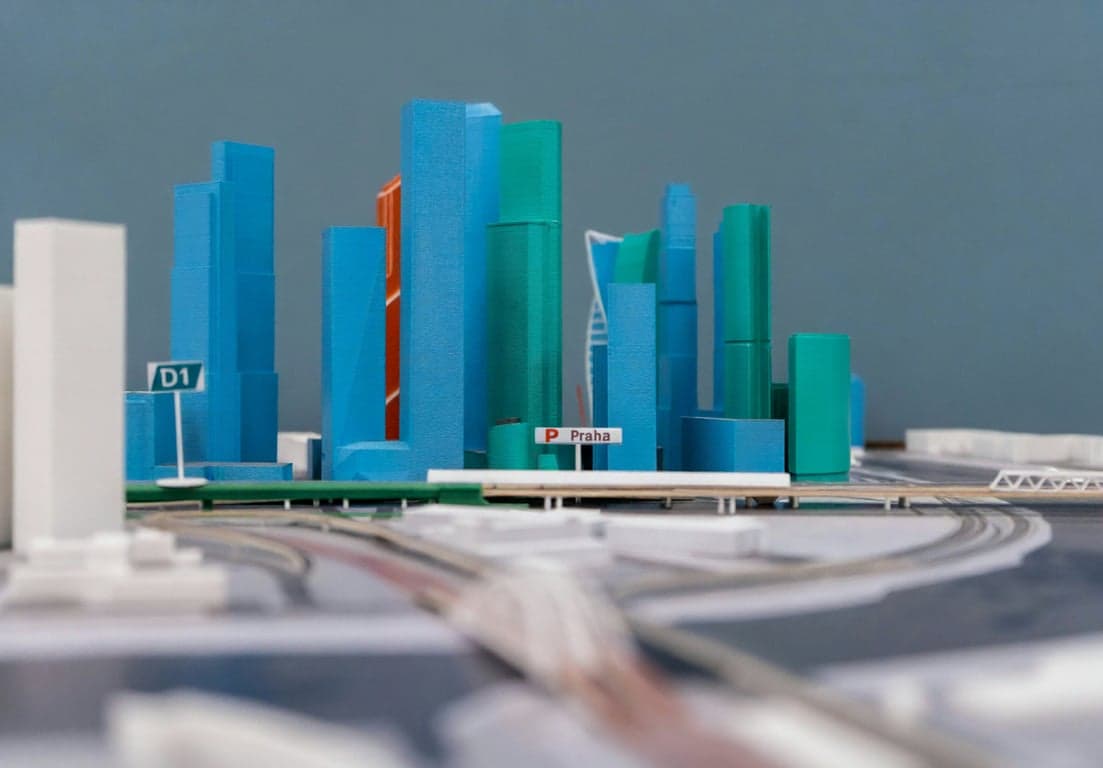
3D printing reduces architectural model production from the traditional 2–4 weeks to just 24–72 hours, cutting costs by up to 80% compared to hand-crafted models. Physical models increase client project approval rates by over 40% compared to digital-only presentations — making them one of the highest-ROI tools in architecture, not unlike physical miniatures and tabletop terrain in tabletop gaming.
Digital visualizations and photorealistic renders are standard in every architectural office today. Yet, nothing surpasses the power of a physical model. The ability to touch a project, walk around it from all sides, and perceive its mass in real space is irreplaceable for clients, investors, and the creators themselves. However, the time and financial demandingness of manual model production has always been a problem. And this is precisely where 3D printing brings a game-changing revolution.
Why Is 3D Printing Faster and More Efficient Than Traditional Model Making?
Traditional architectural model production can take weeks. With 3D printing, this time is reduced to days, or even hours. This speed fundamentally changes the design process.
- Rapid Iterations: Architects can print several variations of a massing study in a short time to better assess which one works best in a given context. Changes in digital design can almost immediately manifest in the physical world.
- Early Error Detection: A physical model often reveals problems with proportions, connections, or the overall impression of a building that can easily be missed in a digital environment. Research shows that an error caught in the design phase costs up to 100× less to fix than the same error discovered during construction.
How Does a Physical Model Help Convince Clients and Investors?
For developers and architects, the ability to clearly and engagingly communicate their vision is crucial for success. A 3D printed model is a powerful tool in this regard.
- Better Client Communication: Not everyone has the spatial imagination to fully visualize a building from 2D drawings or images. A physical model is understandable to everyone and helps prevent misunderstandings.
- Impressive Marketing Tool: A detailed model displayed in a sales center or at a trade fair attracts attention and leaves a much stronger impression on potential buyers and investors than any brochure.
What Complex Shapes Can Be 3D Printed at an Affordable Price?
One of the greatest advantages of 3D printing is the ability to create highly complex and organic shapes with relative ease. Facades with intricate patterns, parametric designs, or complex roof structures, which would be extremely difficult and expensive to produce manually, are straightforward for a 3D printer.
For architectural models, PLA (Polylactic Acid) is most commonly used. It offers an excellent level of detail, is available in many colors (elegant white or grey is popular for architectural models), and allows for printing sharp edges and fine structures. A typical architectural model at 1:200 scale can be printed in 3–8 hours.
Who Uses 3D Printing in Architecture?
3D printing finds application across the entire field:
- Architecture Students: They can quickly and affordably create models for their semester projects and final reviews, allowing them to experiment more and better present their ideas.
- Architectural Studios: They use printing for massing studies, working models, and final presentation pieces for clients and competitions.
- Developers: They commission models of entire residential districts or commercial complexes for marketing purposes.
- Urban Planners: They print models of urban areas for planning and analyzing territorial development.
Materialize Your Vision With Us
You don't have to invest in your own printer and learn a complex data preparation process. Our architectural model service is here to transform your digital designs into impressive reality.
Just send us your 3D model (e.g., in STL or 3MF format), and we'll take care of the rest. We'll help you optimize the data for printing and ensure the highest quality result.
Give your projects a third dimension. Contact us and discover how 3D printing can take your work to the next level.