Cosplay and Props 01/11/2025 Nichita Roilean, Founder 4 min read
Your Dream Costume: 3D Printing for Cosplay
3D printing lets cosplayers produce detailed helmets and armor at a fraction of film-studio cost — a typical breastplate takes 30–80 hours printed in PETG, which withstands up to 75 °C at summer conventions.
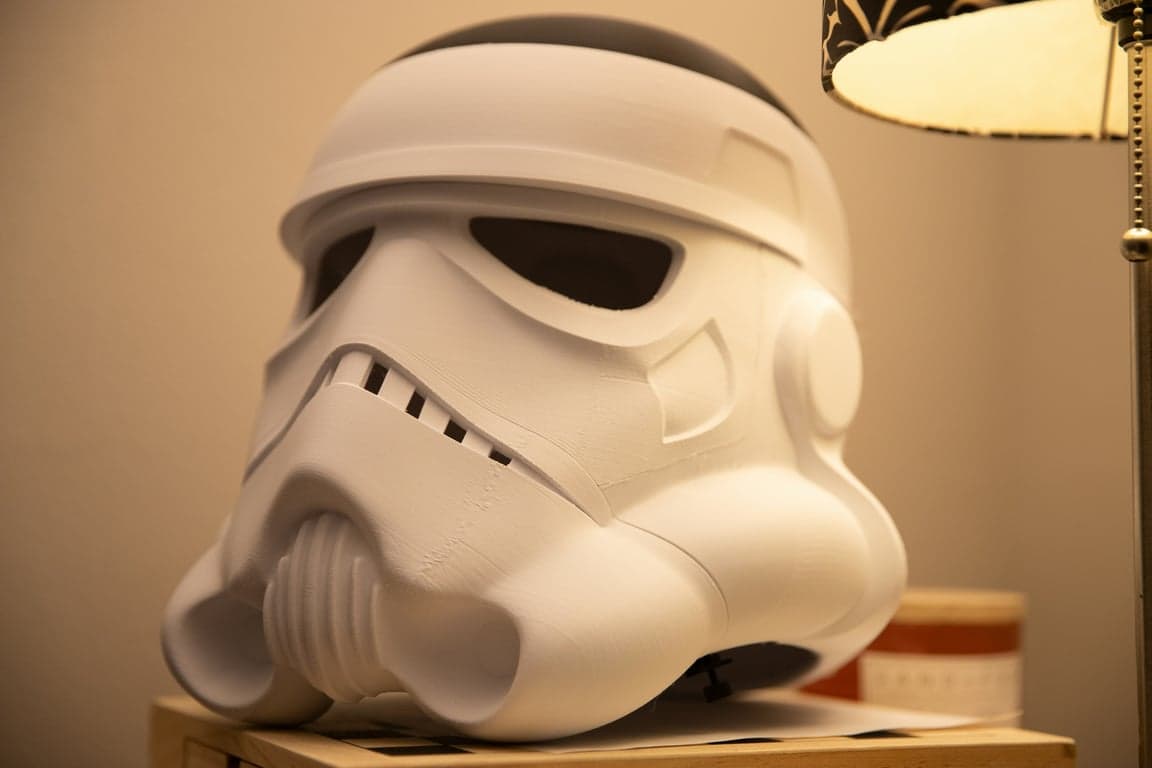
3D printing has become the dominant production method for cosplay props — the Printables.com community alone offers over 500,000 free downloadable models. A complete helmet typically takes 20–50 hours to print in PETG, which withstands temperatures up to 75 °C and is approximately 40% tougher than PLA.
Every cosplayer knows the challenge: how to create complex armor, a detailed prop, or a perfectly fitting helmet of their favorite character? Traditional methods using foam, wood, or paper require immense skill and hundreds of hours of work. Today, however, there's a technology that opens the door to incredible precision and complexity even for beginners – 3D printing.
3D printing has become a revolutionary tool for the cosplay community. It enables the creation of costumes that were previously reserved only for film studios.
1. Precision and Details That Impress
One of the greatest advantages of 3D printing is the ability to replicate even the most complex shapes with digital precision. Do you want a Mandalorian helmet that is indistinguishable from the original? Or a detailed, ornate sword from your favorite video game? With a high-quality 3D model, you can achieve a level of detail that is almost unattainable with manual craftsmanship.
Online databases like Thingiverse, Printables, or specialized marketplaces are full of thousands of helmet, weapon, and armor piece models created by fans for fans.
2. Large Parts? No Problem!
How do you print an entire helmet or breastplate? The trick is to divide a large model into smaller, easily printable parts. These are glued together after printing, and the seams are smoothed with filler. This process allows for the creation of very large and complex armor pieces on any standard 3D printer.
Moreover, models can be easily scaled. This means you can customize a helmet or armor to precisely fit your character for maximum wearing comfort.
3. Which Material Should You Choose for Cosplay: PETG vs. PLA?
For cosplay, two materials are most important, each with different advantages:
PETG (Polyethylene Terephthalate Glycol): For most cosplay props and armor, this is the best choice. It is tough, slightly flexible, and more resistant to impacts and bending than PLA. It tolerates higher temperatures (important for summer conventions where indoor temperatures easily exceed 40 °C) and glues exceptionally well. Its only disadvantage is that it's slightly harder to sand.
PLA (Polylactic Acid): It is ideal for smaller, highly detailed parts that will not be mechanically stressed (e.g., brooches, emblems, small ornaments). It is easier to print and sand, but it is more brittle and has low temperature resistance — it can deform in direct sunlight above 55 °C.
| Property | PETG | PLA |
|---|---|---|
| Strength/Durability | High (tough, durable) | Medium (rigid, but brittle) |
| Temperature Resistance | Higher (approx. 75 °C) | Low (approx. 55 °C) |
| Sanding/Gluing | Harder to sand, glues excellently | Sands excellently, glues well |
| Ideal Use | Armor, helmets, weapons, large parts | Small details, ornaments, non-functional props |
| Typical price/kg | €15–25 | €10–20 |
4. What Does the Full Process Look Like: From Model to Finished Prop?
The creation of a 3D printed prop is a process that combines modern technology with traditional craftsmanship.
- Printing: The model is printed in parts. This step can take tens or even hundreds of hours, depending on size and complexity.
- Gluing: Individual parts are glued together (most often with superglue or epoxy).
- Filling and Sanding: Seams and imperfections are filled with putty, and the entire surface is carefully sanded until perfectly smooth. This step is the most labor-intensive but crucial for the final appearance.
- Primer Coat: Several layers of filler primer are applied to the model to hide the last minor imperfections.
- Painting: The model is painted with colors according to the reference.
- Weathering and Details: Wear effects, scratches, shadows, and other details are added to give the prop a realistic appearance.
How Can We Help You?
Perhaps you don't have your own 3D printer or the time for lengthy printing. That's why we're here. We are enthusiasts of games and movies and understand the needs of cosplayers.
- We'll print any part for you: Send us a link to the model, and we'll print it for you using the most suitable material.
- We'll provide a raw print: You'll receive a glued and basically cleaned model from us, ready for your own creative work – sanding, filling, and painting.
Stop dreaming about the perfect costume and start creating it. Visit our cosplay and props page and let's bring your heroes to life together!